
Most scenic beauty’s(wonderful places)
Ratar gul swamp forest(wonderful places)

Ratargul Swamp Forest is a spectacular freshwater swamp forest located in Bangladesh. Often called the amazon of Bangladesh .it is renowned for its unique, eerie, and fairytale-like aesthetic—especially during the monsoon season when the entire forest goes underwater.
Here is a detailed breakdown of everything you need to know about Ratargul:
🌲 Geography & Ecology(wonderful Places)
- Location: Firstly it is situated in the Fatehpur Union of Gowainghat Upazila, about 26 kilometers away from Sylhet city. It sits by the Goain River and connects seamlessly to the Chengir Khal channel.
- Size: However, The total wetland spans over 3,325 acres. While the core dense swamp forest area covers about 504 acres, which was formally recognized as a Wildlife Sanctuary.
- The Submerging Phenomenon: During the heavy monsoon season (May to October), intense water rushing from the nearby Indian hills floods the basin. The forest gets submerged under 20 to 30 feet of water. The tree trunks are completely underwater, leaving only the green canopies visible. In dry season, the water completely recedes, exposing the muddy roots and small internal lakes/ponds.
🐍 Flora and Fauna
Ratargul boasts a rich biodiversity split across its unique semi-aquatic layers:
- Plant Life: There are roughly 73 recorded species of plants. The predominant tree is the Koroch tree (Millettia pinnata), alongside Hijal and Barun. The forest exhibits a distinct two-layer plant system. That is the top canopy spreading up to 15 meters high and a dense lower layer of water-soluble cane and reeds .
- Wildlife: It is home to many species of snakes (including various water snakes), monkeys, water monitors, and mongooses (visible mainly in the dry season).
- Birdwatcher’s Paradise: You can easily spot herons, egrets, kingfishers, kites, and eagles. During the winter months, the remaining lakes within the forest become a temporary home to thousands of migratory birds.
🚣♂️ Tourism & The Experience
To truly experience Ratargul, you must explore it on the water.
- The Boat Journey: Motorized boats are not allowed inside the core sanctuary to preserve its calm environment. Visitors hire traditional small wooden dinghy boats rowed by local fishermen. Drifting silently through the narrow watery trails under the overlapping green canopy is an unforgettable experience.
🗺️ Travel Information & Logistics
- Best Time to Visit: The absolute prime time is during the late monsoon, from July to October, when the water level is high and the vegetation looks vibrantly alive.
- How to Get There: From Sylhet city (like the Amberkhana or Bandar Bazar points), you can hire a local CNG auto-rickshaw or a private vehicle to take you to the entry ghats (such as Motorghat or Chowranghi Ghat). The drive takes roughly 1 to 1.5 hours.
- Costs: A local entry fee applies (around BDT 58 per person). And a non-motorized boat for a 1–2 hour tour through the forest generally costs between BDT 750 and BDT 1,200 (fitting up to 4–6 people).
Tanguar Haor(wonderful places)

Here is the information to help you finish your post on Tanguar Haor in the WordPress editor:
🌊 Geography & Ecology
- Location: Situated in the Dharmapasha and Tahirpur Upazilas of Sunamganj District, nestled right below the foothills of the Meghalaya hills of India.
- Size & Scale: It is the second-largest freshwater wetland in Bangladesh, encompassing over 120 interconnected beels (lakes) and 46 floating island-like villages.
- The Seasonal Transformation: During the monsoon (June to October), it swells into a massive, clear “inland sea” covering nearly 20,000 acres. In the winter dry season, the water recedes to expose a stunning mosaic of agricultural land, smaller lakes, and reedbeds.
- Ramsar Site Status: Recognized internationally for its unique ecosystem, it was declared an Ecologically Critical Area in 1999 and became Bangladesh’s second UNESCO Ramsar Site in 2000.
🦅 Flora and Fauna
- Birdwatcher’s Paradise: It is one of the richest bird sanctuaries in South Asia. In the winter months (November to February), it acts as a temporary sanctuary for over 250 species of migratory waterfowl flying in from Siberia and Europe, including rare species like the Baer’s Pochard.
- Aquatic Life: The haor serves as a massive breeding ground for fish, hosting over 140 freshwater species alongside numerous reptiles and amphibians.
- Swamp Forests: Features beautiful patches of water-tolerant Hijol (Indian Oak) and Koroch trees standing gracefully submerged in the water.
🚣♂️ Tourism & The Experience
- Houseboat Cruising: Unlike Ratargul’s day-trips, the ultimate way to experience Tanguar Haor is by renting large, traditional wooden houseboats. Many tourists opt for 2-day, 1-night safaris where they sleep, eat, and live on the water.
- Crystal Clear Waters: In many parts of the haor, the water is so pristine and transparent that you can easily peer down and see the lakebed below.
- Nearby Attractions: Most boat tours pair a visit to the haor with nearby scenic spots like the Jadukata River, the green hills of Bareker Tila, and the vibrant Niladri Lake (Chunapathorer Lake).
🗺️ Travel Information & Logistics
- Best Time to Visit:
- Monsoon (July to September): For the breathtaking “endless ocean” aesthetic and houseboat cruising.
- Winter (November to February): For birdwatching and pleasant, cooler weather.
- How to Get There: From Sylhet, travelers take a 3-hour road trip to Sunamganj town. Then head to the main boat launching ghats at Tahirpur or Shaheb Bari Ghat via local CNGs or motorbikes.
Sri Mangal
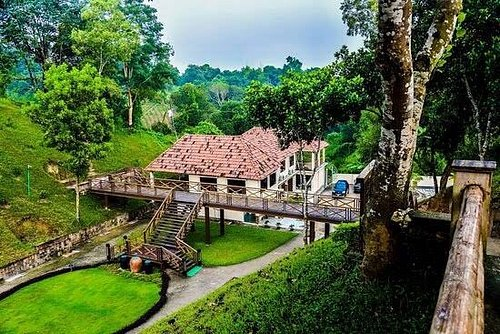
🌲 Geography & Ecology
- Location: Situated in the Maulvibazar district of the Sylhet Division, in the northeastern part of Bangladesh.
- The Tea Capital: It is globally and locally recognized as the “Tea Capital of Bangladesh”.
- Climate & Landscape: Unlike the wetland haors, Sreemangal features a hilly terrain, dense rain forests, and a grand canopy of rubber, pineapple, and lemon plantations. It also records some of the highest rainfall and coolest winter temperatures in the country.
🐒 Flora and Fauna
- Lawachara National Park: A major semi-evergreen rain forest sanctuary located here. It is home to the critically endangered Western Hoolock Gibbons, capped langurs, slow lorises, barking deer, and various species of snakes.
- Birdwatcher’s Haven: The forest and nearby wetlands host over 240 species of birds, making it a premier destination for wildlife photographers and birdwatchers.
- Baikka Beel: A nearby wetland sanctuary that serves as a major breeding ground for local fish and a safe haven for thousands of migratory birds during the winter.
☕ Tourism & The Experience
- The Famous 7-Layer Tea: Mainly a legendary local specialty found at Nilkantha Tea Cabin, where a single glass features distinct, colorful layers of different flavored teas.
- Tea Estate Cycling: One of the best ways to experience Sreemangal is renting a bicycle and riding through the quiet, shaded trails of the tea estates (like the Finlay or Ispahani gardens).
- Tribal Villages: Visitors can visit the indigenous communities of the Khasia and Manipuri tribes to learn about their unique culture, traditional dress weaving, and betel leaf cultivation.
🗺️ Travel Information & Logistics
- Best Time to Visit:
- Monsoon (June to September): For witnessing the tea gardens at their absolute greenest, vibrant, and most alive state.
- Winter (November to February): Ideal for trekking inside Lawachara National Park and birdwatching at Baikka Beel without the humidity.
- How to Get There: From Sylhet city, it is a highly accessible 2 to 2.5-hour journey by train or private car/bus. It is also directly connected to Dhaka via regular intercity trains (like the Parabat or Upavan Express).
- Accommodation: Offers a massive range of options, from budget eco-resorts near the forest to ultra-luxury tea resort bungalows.