
Some beautiful places in Bangladesh(Best Places In BD)
Ahsan Manjil
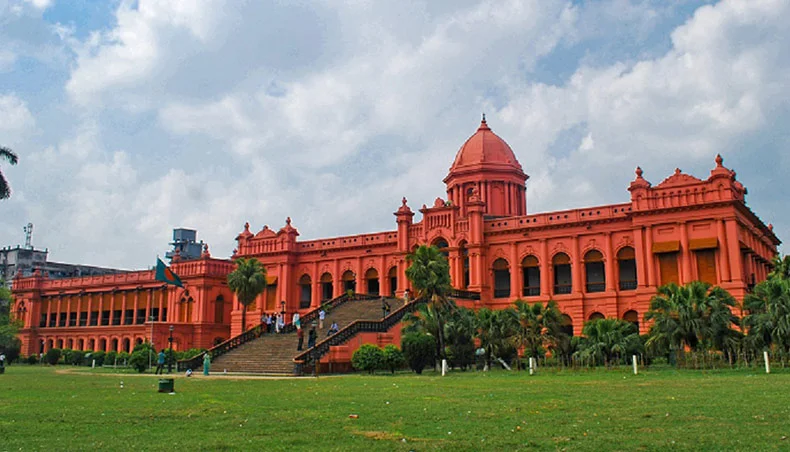
Ahsan Manzil (Best Places In BD)is one of the most significant architectural and historical monuments in Bangladesh. Located at Kumartoli in Old Dhaka along the banks of the Buriganga River. It served as the official residential palace and seat of the Nawabs of Dhaka.
Here is a breakdown of its history, architecture, and current status:
1. History & Origins of Ahsan Manjil(Best Places In BD)
- Mughal & French Roots: In the Mughal era, the site was originally a garden house (Rangmahal) belonging to a landlord named Sheikh Enayet Ullah. In the 1740s, his son sold the property to French traders, who used it as a prominent trading center.
- The Nawab Era: In 1830, Khwaja Alimullah purchased the property from the French and converted it into his residence. His son, Nawab Khwaja Abdul Ghani, began constructing the grand palace on the site in 1859, completing it in 1872. He named it Ahsan Manzil after his son, Nawab Khwaja Ahsanullah.
- Political Cradle: The palace was a major hub for regional politics. In 1906, crucial meetings held here led to the formation of the All India Muslim League.
2. Architecture & Design
- Indo-Saracenic Style: The palace is a brilliant example of Indo-Saracenic Revival architecture, blending European grandiosity .
- The Grand Dome: Its most striking feature is the massive octagonal dome that sits 27.13 meters above the ground, designed to resemble a lotus blossom.
- Layout: Built on a raised platform, the two-story building features a broad front facing the river. An open staircase extends from the southern portico directly down toward the Buriganga River.
3. Destruction and Restoration
The palace suffered heavy damage during a devastating tornado in 1888. Nawab Ahsanullah undertook massive reconstruction efforts, which is when the present exquisite dome was added. Over the mid-20th century, the palace fell into neglect and decay. Recognizing its immense heritage value, the Government of Bangladesh acquired and beautifully restored the property in the late 1980.
Shompur Bihar(Best Places In Bd)
Somapura Mahavihara is one of the most famous ancient Buddhist monasteries in the Indian subcontinent. Located in Paharpur, Naogaon, it is one of the most crucial archaeological sites in Bangladesh and was designated as a UNESCO World Heritage Site in 1985.
1. History & Origins
- The Pala Golden Era: Built in the late 8th or early 9th century CE, the monastery was commissioned by Emperor Dharmapala. He is the second ruler of the famous Pala Dynasty, which was highly renowned for its patronage of Buddhist art and learning.
- Intellectual & Cultural Hub: Mostly Shompur Bihar functioned as a vast ancient university. It attracted scholars, monks, and students from across Asia—including Tibet, China, and Southeast Asia—to study philosophy, astronomy, logic, and medicine.
- Decline and Forgotten Era: As Buddhism began to wane in the region and political shifts occurred over the centuries, the great monastery was gradually abandoned by the 12th century. It became completely buried under mounds of earth, appearing as a hill until it was rediscovered and excavated.
2. Architecture & Design
- A Gigantic Complex: Spanning over 27 acres, it is the largest Buddhist mahavihara in the region. The main courtyard forms a massive quadrangle enclosed by 177 monastic cells.
- The Central Terraced Stupa: Dominating the entire complex is the monumental central temple. It features a unique cruciform basement and a tiered. And dwindling pyramid design that rises roughly 72 feet from the ground.
- Global Influence: Its distinctive terraced architectural design was deeply influential. It serve as a blueprint for iconic Buddhist temples built later across Southeast Asia in places like Myanmar, Java (Indonesia), and Cambodia.
3. Artistry and Artifacts
- Terracotta Plaques: The outer base walls of the central temple are adorned with thousands of ornamental terracotta plaques. These artworks intricately depict the daily life, folklore, animals, and religious stories of ancient Bengal.
- Harmonious Confluence: While built as a Buddhist monastery, the site has unearthed numerous stone sculptures, inscriptions, and plaques depicting Hindu deities and Jain influences, showcasing a remarkable period of religious harmony and cultural coexistence.
Cox’s Bazar(Best Places In BD)
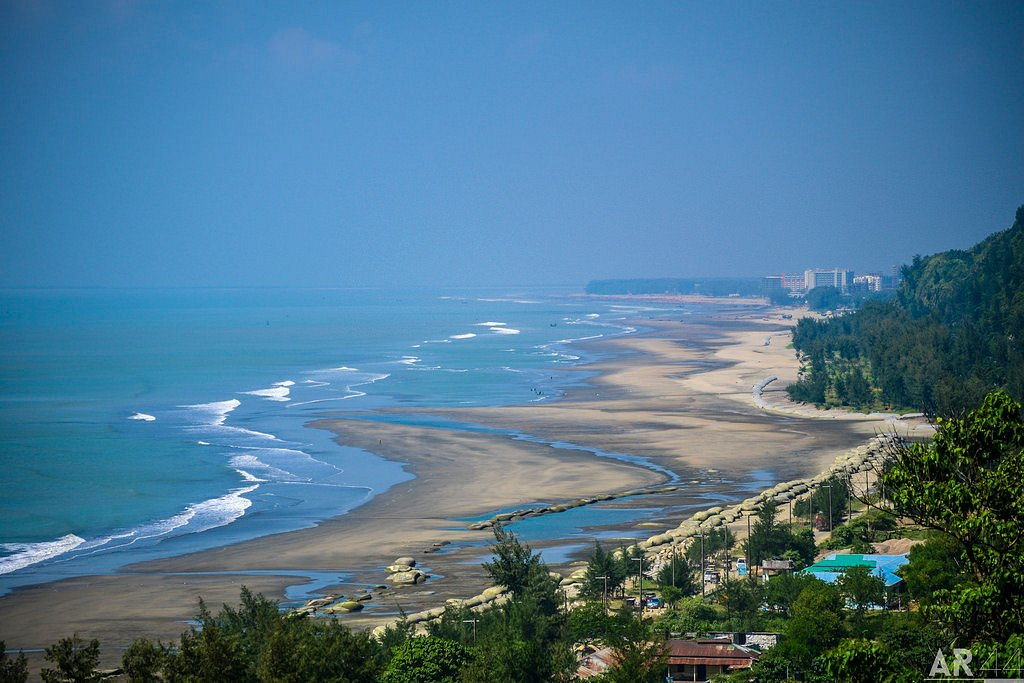
Cox’s Bazar (historically known as Panowa or Palongkee) is the premier seaside resort and tourist capital of Bangladesh. Located 150 kilometers south of the industrial port of Chittagong, it is world-renowned for housing the world’s longest unbroken natural sandy sea beach, stretching an incredible 120 kilometers along the Bay of Bengal.
1. History & Origins
- The Mughal Legacy: The known history of the region dates back to the Mughal era. In 1660, while traveling to Arakan, the Mughal Prince Shah Shuja was so captivated by the scenic beauty of the area that he ordered his army to camp there. A place Dulahazara (meaning “one thousand palanquins”) still stands today to commemorate the historic royal halt.
- The British Connection: The modern town derives its name from Captain Hiram Cox, a compassionate officer of the British East India Company. In the late 18th century, he was appointed superintendent of the outpost to rehabilitate thousands of Arakanese refugees. Following his passing in 1799, a local market was established and named “Cox’s Bazar” (Cox’s Market) to honor his humanitarian work.
- Becoming a Tourism Capital: Initially a quiet fishing community, the municipality saw intentional development post-independence. Notably, its first chairman, Captain Advocate Fazlul Karim, planted the iconic Tamarisk forest. which is along the beach to curb tides and establish a scenic coastline, paving the way for the bustling resort hub it is today.
2. Geography & Landscape
- The 120km Sandy Coastline: Unlike most commercial beaches, the beach here features a remarkably gentle slope. Consists of uninterrupted fine golden sand flanked by the warm blue waters of the Bay of Bengal.
- Where Hills Meet the Sea: The true geographic marvel of Cox’s Bazar is its eastern backdrop. The coastline seems massive, lush green tropical hills belonging to the Dupitilla geological series. It creats a dramatic landscape where towering cliffs directly meet the ocean waves.
- The Marine Drive Corridor: The district boasts the breathtaking Cox’s Bazar–Teknaf Marine Drive. 80-kilometer-long scenic road nestled between the hill tracts on one side and the surging sea on the other. It ranks among the most spectacular coastal drives in Asia.
3. Top Attractions & Spots
- Inani Beach: It is situated roughly 33 kilometers south of the main town. Inani is highly celebrated for its crystal-clear blue waters and unique golden-black rock formations. It features an abundance of natural coral reefs that emerge during low tide.
- Himchari National Park: Located a brief drive from the main beach town, Himchari is famous for its refreshing cold-water hill fountains and waterfalls. A climb up the high cliff stairs offers an unparalleled, panoramic view of the vast, expanding horizon of the Bay of Bengal although.